It's well-known at this point that LLMs give precedence to content that is more recent. The "recency" lever has been pulled by many agencies in different ways, including everything from making meaningless updates (a waste) to amping up content production.
Most advice about "evergreen" content is about the writing: keep it current, update the dates, refresh the stats. Almost nobody talks about the URL. But the URL is a signal too — and in the citation data I've been collecting, one small piece of it keeps showing up.
Pages whose URL slug contains a four-digit year — /blog/2023/zero-trust-guide, /2024/01/best-edr-tools — fall out of AI citations faster than pages that don't.
The signal is consistent enough, and actionable enough, that it's worth putting in front of people who are making decisions about their content right now.
What I'm measuring
Quoted runs a weekly job that asks the same prompts of ChatGPT's search, Claude's search, and Perplexity, and records which URLs each engine cites. Do that for a few weeks and every cited URL gets a simple label: sticky if it was cited in three or more distinct weeks, transient if it showed up fewer times and then dropped out.
"What stays cited and why" is the whole question we are asking, so the interesting move is to take a content feature and ask: do sticky pages have more or less of it than transient pages? Here the feature is binary — whether the URL slug contains a four-digit year or not.
The result
The same direction shows up in two different slices of the data.
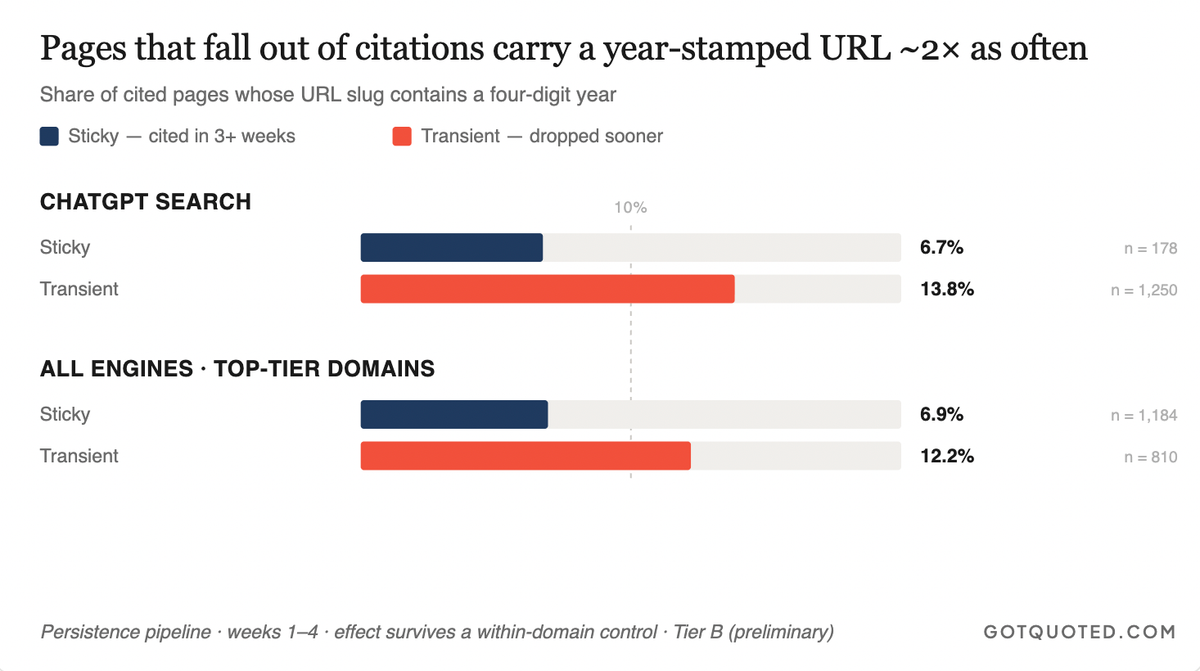
| Slice | Sticky pages with a year in the URL | Transient pages | Effect (Cohen's d) | p |
|---|---|---|---|---|
| ChatGPT search | 6.7% (n=178) | 13.8% (n=1,250) | −0.235 | 0.0009 |
| All engines, top-tier domains | 6.9% (n=1,184) | 12.2% (n=810) | −0.181 | 0.0001 |
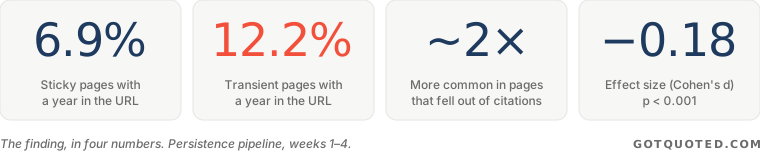
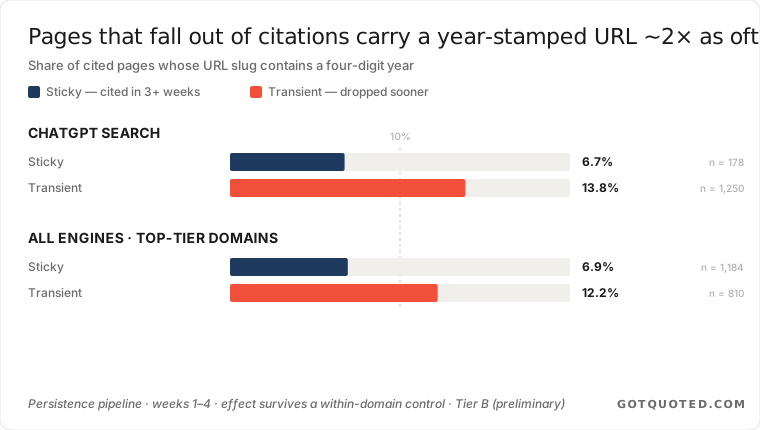
Pages that fell out of citations had years in their URLS twice as much as pages that stayed cited. The effect size is statistically clean (p < 0.001) and it points the same way in both the ChatGPT-only slice and the pooled, top-tier-domain slice.
The thing I find most persuasive isn't the p-value — it's that the effect survives a within-domain control. One obvious worry is that this is really a domain story: maybe low-authority sites both use dated URLs and get dropped from citations, and the URL has nothing to do with it. So for each feature I also check whether the pattern holds inside individual domains — comparing a domain's own sticky pages to its own transient pages. It does. That rules out "it's just a proxy for site authority."
What it might mean
The most natural reading is that a four-digit year in a URL is a time-stamp, and AI engines treat time-stamped URLs as time-bound. When an engine re-answers a question weeks later, a URL that announces "this is the 2023 version" is an easy thing to swap out for a fresher-looking equivalent. The content may be perfectly current; the URL says otherwise.
If that's right, it's a cheap, structural mistake. A CMS that auto-prefixes posts with /2024/01/ is quietly putting an expiry date on every page it publishes — for the AI-citation surface specifically, separate from anything Google does with it.
What I'd do with this
At this confidence level, the asymmetry is favorable: the downside of not putting a year in an evergreen page's URL is zero, and the possible upside is a longer life in AI citations. So if you're publishing something you want to keep getting cited — a guide, a definition, a reference page — I'd keep the year out of the slug, and I'd look hard at any CMS that's auto-dating your URLs for you.
What's next
We are always re-assessing our insights at Quoted—that's what makes our intelligence actionable and timely. Something that works now might not work in two months—that is the new reality of AEO, and I am committed to providing businesses with a response to the rapid evolution.
If you're interested in following one of our verticals for private insights, or would like to explore starting your own private AEO research project, click here to explore what Quoted has to offer.